Sunday, 22 February 2015

101 Quiet Cities -> Coming Soon to Kindle

101 Quiet Cities has now been proofed, and uploaded to Amazon, it is currently awaiting publication to Kindle. 

I am sure that there are still typos in there, and happy to take out any that anyone points out. Amazon Kindle let you update your books whenever you feel the need. 

I am expecting it to appear on the Amazon Store for purchase within the next couple of days. 

It is perhaps early days to be saying too much about the process, but although it took more than a few minutes it was reasonably straightforward to upload the collection from Scrivener onto the Amazon website. There is plenty of guidance available. The trickiest aspect seemed to be getting reference numbers for my bank account, but they are provided as part of the online banking service. Amazon kindly provided a graph indicating what level of pricing attracts what level of sales and author earnings. It suggested a price of over $2, which although it generated less sales, generated more author earnings because the 70% royalty rate kicked in, whereas you are limited to a 35% royalty rate below that. For the time being I have set the price as low as possible, I think that means that I will earn less that 30p per title sold, which seems pretty poor, but compared to traditional publishing is not that unreasonable. I might review pricing in future, but for the time being just shifting some copies  and letting people read it seems for the best. 

If you do like the book, then I am totally delighted, and you might also like John Sladek, JG Ballard, Jorge Luis Borges, The Following Story by Cees Nooteboom, A Bad Day for the Sung Dynasty by Frank Kuppner, Mervyn Peake, and just mountains of science fiction stuff.

In terms of reading about cities I would heartily recommend, 

  • Jane Jacobs, The Death and Life of Great American Cities 
  • Rem Koolhaas, Delirious New York
  • Geoff Manaugh, the BldgBlog Book 
  • Ricky Burdett and Deyan Sudjic, The Endless City
  • Stewart Brand, How Buildings Learn, 
  • V Gordon Childe, not terribly accessible these days, but if you can find it the Method and Theory of V Gordon Childe by Barbara McNairn it is highly recommended, 
  • the art of Lebbeus Woods is also worth investigating. 

Now that I have finished 101 Quiet Cities, I will either return to another collection of short stories, Losing Definition, or set about published to Kindle an earlier short thriller I wrote years ago. The collection called Losing Definition is a lot longer than 101 Quiet Cities, probably around fifty thousand words in total, rather than the rather jewel like seventeen thousand of 101 Quiet Cities. Losing Definition is a lot looser in theme and format, with a mix of stories, some longer, some shorter, with some themes across sets of stories, but no overall overarching structure. I have really loved the format of a five hundred word story on an imaginary city, it is such a great format that I am surprised that everyone doesn’t use it all the time. I might do a few more imaginary cities one of these days. I was wondering if you could use the same format for stories about imaginary buildings but I really cannot think of any for now.

Having been tightly constrained by one format, it will nice to be able to do something completely different next time. 

If you liked the short city stories published here, then check out 101 Quiet Cities, when it does appear. If you like it, tell your friends, tell everyone, if you don’t, well it cost less than a cup of coffee. 


Saturday, 14 February 2015

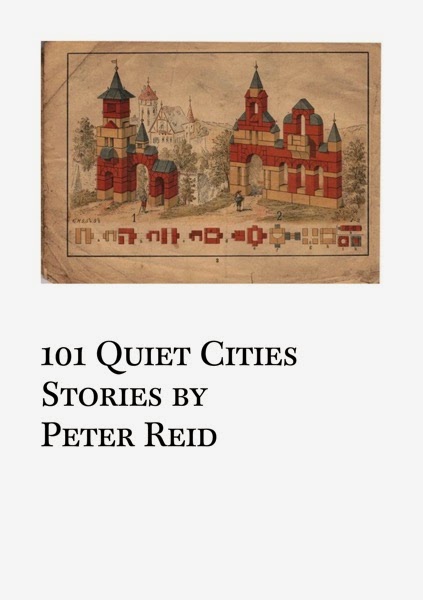
101 Quiet Cities

101 Quiet Cities  cover jpg


I have published a few short stories about imaginary cities here. Pretty early on I realised that I liked the format, and would just press on to prepare a whole collection on imaginary cities. The format is basically around five hundred words on an imaginary city, ideally with some sort of twist or observation included. On writing them some themes have emerged, a few modern composers are named, a few real cities are alluded to, representation and reality feature. Quite a few are basically dreams that I have written out in story form. 

I suppose the basic inspiration was Invisible Cities by Italo Calvino, but equally the spoof academic tone of the early Peter Greenaway shorts, like A Walk Through H, has been an influence. 

I have also provided some framing stories and incorporated some lines and ideas that I have been kicking about forever. 

The collection is now largely complete, so I am at the final proofing stage. I have written the stories on Scrivener (for Mac), and that allows me to format for Kindle, but it is a bit tricky. Having said that, it is like doing a web page, have a go, check it on a few devices, have another go, and carry on till you arrive at something you are reasonably happy with. Scrivener will let me prepare a version for Kindle and then the Amazon Send to Kindle App lets me send it to my own Kindle. It is amazing to read your own work on a Kindle, with Scrivener you can add a cover and contents, etc, so it does have the potential to all look very professional. 

There is also the usual proofing for typos and the like, not sure whether I will just print it all off and proof that, or proof on my Kindle, or a mixture of both. The whole collection comes in at under twenty thousand words, so it should not take too long.

Things are pretty busy at work, so it might be a wee while before I finally have it all uploaded to the Amazon store, but not far off now. 

Sunday, 21 December 2014

The Christmas Card (Lawyer's) Regulations 2014

1. These regulations are The Christmas Card (Lawyer’s) Regulations 2014 and may be referred to as the ‘card’.

2. The ‘card’ is deemed to take effect from the issue date which is taken as the date of delivery to the recipient. In the event of dispute the issue date may be taken to be the date that follows the posting date, by the a period equivalent to the seasonal average delivery time. 

3. (a) The recipient of this card may at times be referred to as ‘you’, and the sender of this card may at times be referred to as ‘I’.

(b) The recipient of this card is instructed that they must, have an enjoyable and relaxing Christmas, and;

(c) that they may have a prosperous and healthy year commencing on the first of January, on the calendar year following the issue of this card.

4. Regulation 3(c) is subject to force majeure and no liability is imposed upon the sender of the card. 

5. Where the card has not been received by the recipient it is deemed to have no effect, further:

(a) the recipient must be an natural person,

(b) the recipient must not be:

(i)  a limited company;

(ii) partnership, or;

(ii) other non natural legal entity.

(c) the recipient must be as specified on the enclosing envelope and detailed on the card. 

(d) where either or both 5(a) and 5(c) are not met, then the card is deemed to have not effect. 

6. These regulations are to be automatically revoked on 1 January 2016, this regulation takes precedence over regulation 3.


Friday, 5 December 2014

Ligeti Spit

IMG 3336


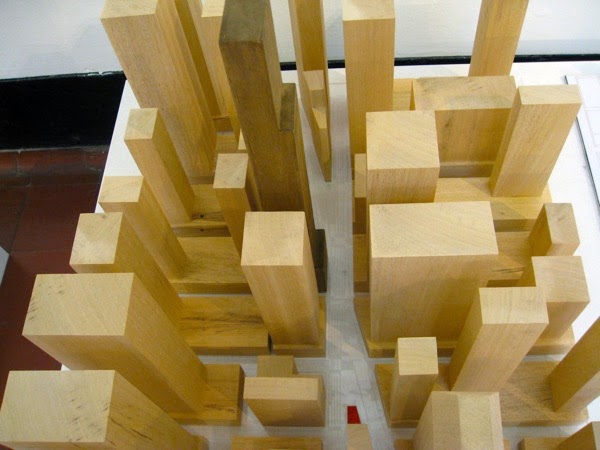
If ever one were tempted to compare a city to a clock, or some other finely wrought old machine, then one cannot have in mind this city. It is now called Ligeti Spit, although the original settlers, on first arrival, had called it Breughelland. It lies at the far extreme of a spur of land, within a muddy estuary. The spur of land is but one among many, and was apparently chosen at some haste. It is not markedly any more suitable for the purpose than any other of the rather similar such marshy promontories that jut out into the cold waters.
There is a certain ragged grace to the place, great concrete towers punctuate the skyline, and a huge area of parkland lies at its centre, as if the growing city had decided to just get all of its green space out of the way, curtly in one single hasty move.

The city bristles with towers, some squat, some elegant, in so much as a collection of needles can ever aspire to such things. As with the buildings, so with the people. They vary from those who are painfully squat, perched awkwardly on high stools, drinking endless beverages boiling hot and strong with various stimulants. Their talk and observations are pithy and viciously opinionated brooking no scope for discussion or argument. Other residents are as needle thin, as their buildings. Angular in their grey clothing, ironed in creases only accentuating their spikiness. The needle thin residents apparently have no time to stop and talk, and are no less fierce in their views than their more sedentary compatriots.

At all times, at all places, all is struggle. The people are constantly travelling, but seldom do they journey together, they always have slightly different destinations, they are always jockeying for position, edging closer to the front of any queue, whenever any chance presents itself, their elbows are sharp, their eyes will never meet yours.

To the visitor it is never clear what the city does or what the people do. It is forever as if, when something is to all intents and purposes finished, the residents have found some new cunning way to wrestle out some further money by performing some further function on it. So they might be criticise things that others have made, or extract a fee from selling options to do things, or to refrain from doing things, but such options are so opaquely split up and bundled together, so that it is never quite clear what you actually be paying for.

There are sayings around the theme that whenever you are making a deal there, you are always on the wrong side of the deal, any profits you might have been promised turn to huge liabilities. It is a city of lawyers, endlessly tangling up the unwary in contracts and unwanted obligations, offering silky words and pie in the sky, until you end up a virtual slave, paying their usurious fees and rates until the day you die.

It is the busiest, the noisiest, the fastest of places, nothing is still, nothing is settled, there is neither good nor bad, in all that is there. The only merit is in the new, novelty is always valued, always praised for as long as the glossiness and factory fresh smell lasts, and then it too is condemned to, at best, the same impatient indifference as most else, or even the particular vituperation reserved for that which has recently fallen from favour.

Thursday, 16 October 2014

Voisin

IMG 2893


It was a lively day in the city, the air rich with the smell of spices, and the constant bustle of hawkers and stallholders all around us. My friend was up ahead, and I pushed through the crowd to catch up with her. Momentarily I lost sight of her, and I pushed on through the crowd, placing my hand on a back here, nudging between some shoulders there. I saw a door that I had never noticed before closing and caught it before it had fully shut.

In truth the other side of the door was nothing remarkable, little different from the bustling market space that I had left. There was another open market space, with the usual stalls, and up ahead a narrowing in the pillars to create a seeming corridor that shaded into darkness. I could see her mane of bright red hair for a moment but then she vanished into the darkness. I resolved to take my time, I had not noticed these stalls before and it was still early in the day.

The first stall was surrounded by a frantic crowd but when I got through I found that it held only a strange array of broken clock parts. Similarly the next stall was thronged but merely displayed a selection of broken glass, that had seemingly been dug up, the dirt still sticking to it. The further I ventured from the door, that I had passed without thinking, the more I noticed that which was at odds with all that I was familiar with. It seemed that everyone was wearing clothes that they had made themselves, they carried jute sacking or canvas, with which to wrap anything they might buy. A hurdy gurdy played a tune I did not recognise, the hot foods were with dipped in a sauce that glittered and glowed, when I looked at the seller, I noticed that his buttons were improvised pieces, sewn onto his coat, each a different size and shape, pottery punched with holes, stubby twigs.

Beyond a row of pillars was an expanse of round tables, the crowds were less dense, and despite the intensity of those sitting round the tables, it seemed more relaxed than the market space. I sat at one table, slowly realising that those round the table were gambling, I could not recognise the game, it involved strange tokens and playing cards that I could not recognise, their heads were down, as they studied the cards and tokens intently. One head was raised momentarily, and I recognised Simon an attorney from an office near where I worked. His eyes flashed brightly, he nodded in recognition and signalled me to come over. As I knelt down beside him, he welcomed me to the city of Voisin. Although his smile was bright and friendly and his tone welcoming, I could tell from his eyes that he was anxious for me. In a whispered voice he told me that in Voisin it is not done to wear a hat or scarf, and I should discard them as soon as possible. I could tell from his tone and seriousness that it was important not to react to any of this, to treat our conversation as mere friendly words, some chit chat, or commonplace remarks. I nodded that I understood, when it was clear that I did not. I made to stand up, and he beckoned to me one last time, I bent my head closer to him, he mouthed some words to me. The deeper you go, the more dangerous it gets.

I nodded to let him know that I understood, when, in truth, I did not. I left the table and wandered on, with the rough idea that the unexpected door that I had come through lay somewhere behind me. Without looking at anyone I slipped off my scarf and hat, and a few paces later dropped them in the gap beneath an empty table which was draped with a pale cloth.

On looking around me, it was increasingly obvious to me that this was not the city that I had come from, although on first glance it looked the same. Things were made of painted cardboard, like the scenery at the theatre, canvas was stretched over straw, and crumpled paper filled gaps.

I resolved to …

Sunday, 12 October 2014

Quipu

IMG 3376


I have heard tell, from explorers and other travellers of the city of Quipu. It lies deep in the jungle, a thousand miles from civilisation. The jungle there is wet with constant rain, the trees are loud with colourful frogs calling, and tiny bright fish swim in the puddles caught perpetually in the folds of the trees. It is even said that the great river that flows down to Mahogany has its source in that region, though I do not know whether that is true.

The region is so endlessly moist, that no paper could possibly survive. There are no books in that place, nor so much as a single piece of paper. Explorers tell how their normal clothes rotted on their backs, any metal rusted and stained, their buttons reduced to green smudges on their shirts.

Any books and notes that travellers had carried with them rotted in the hot humid atmosphere, turning to mush, like a wasps’ nest that you find in late summer in some neglected spot. But the people of Quipu are undeterred by such things and do not recognise them as an inconvenience, instead of paper, or even impressions on clay, as I have seen employed elsewhere, they rely solely on knots tied in the string they make. There are numberless varieties of knots, and the distance between knots is equally telling, in conveying meaning and nuance. Their entire civilisation is recorded on these knotted twines, they organise their accounts in this manner. Their rulers convey orders to distant subjects, lovers share fond memories.

While their civilisation appears unconventional to our eyes, it is successful by all the usual metrics, excelling in such arts and trades as we might recognise, with one great lacuna. Without the lens of the blank paper, without the rectangle of an empty page before them, they have no architecture that we could recognise as such. They have no understanding of right angles, the perpendicular or the level. They do not recognise a straight line, or the angles that it can describe.

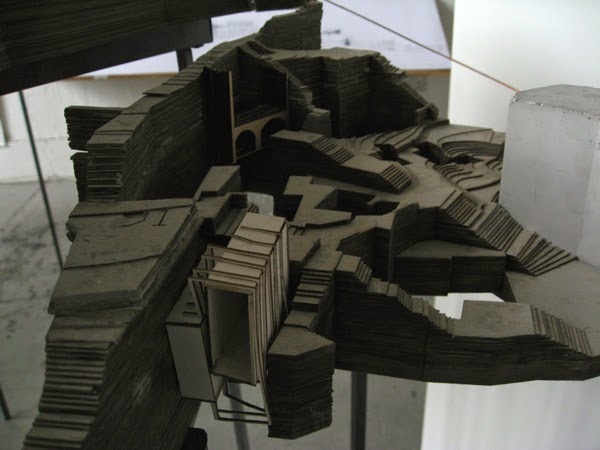
For the people of Quipu, all is curves and possibility, there is space or there is not space. Their whole city is heaped opportunistically where there is space to put it. When the mood, or the need takes them, they will make a rough wall, piling clay woven with threads, letting the wall fall where it will enclosing what it can. The overall effect is of something natural, like bird nests clustered close together in a tree, or coral slowly tumbling across the ocean floor.

Having never seen a straight line, they think that their way of life is perfectly natural, and for the people of Quipu they truly believe that they are lacking for nothing at all in their strange city in the jungle moistness.

Thursday, 9 October 2014

Lux

IMG 3330


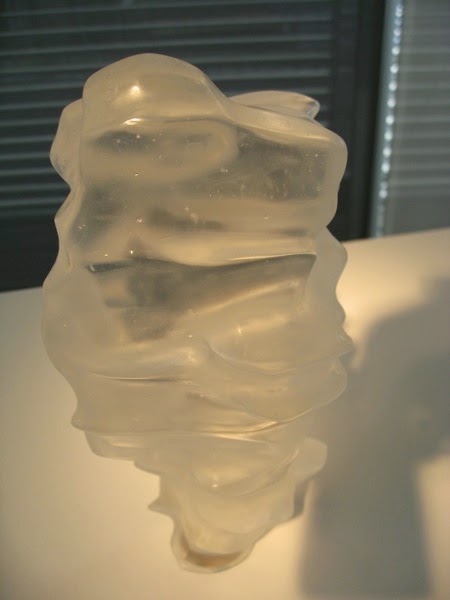
The strangest thing that I ever saw, was when I was a child in the desert. We passed a camel, carrying a great curved slab of water. This was not cold like ice, but crystalline water. There was no container, merely ropes to fix it in place, I was told that some light wires were submerged in the mass, and there was a battery to provide a modest trickle charge forcing the water to retain its crystalline form. A few metres in height and breadth, it was curved coming to a peak, heavier at the base. The water seemed cloudy, translucent rather than particularly dark or clear. I was told that at the flick of a switch it would resume its natural form, a sudden deluge of warm water. In this way, the nomads would carry great chunks of water across the desert to their dwellings or for trade.

Once the camel had crossed our path, carrying the huge slab of water, it headed on, I know not where. I was a child and full of questions, and there were only a few answers available, the camel had come from the city of Lux, a desert city crafted entirely in this crystalline water. The natural shapes of water in this form had dictated the layout and architecture of the city, great stocky walls, coming to distant peaks. The city shone out in the harsh desert light, a welcome landmark for travellers.

Now I am much much older and no one can remember the city of Lux, the technology of crystalline water has been lost, like those of flexible glass or Greek fire. I asked myself what would be left of a city in the desert made of crystalline water?

I was curious so I spent years in the desert, following the desert ways, until at last I found a high place in the desert, a sea of broken rocks amidst the desert sands, a place too barren to linger. There was a tangle of crude copper wires and primitive old batteries. The materials looked so very old, as if they had been there for decades and had been rotten with age even a century ago. In dismay I looked at the wires and pottery batteries, crude mineral anodes and cathodes, nothing at all remarkable. There was nothing there to convince anyone of the story of crystalline water. I was ready to leave, when I caught a glimpse of the sun reflecting off something. In a cleft in the rock there was a single slab of crystalline water, I went to it and reached out to touch it, it was warm, as a rock in the desert and smooth too. The surface was worn and pitted, like the outcropping stones around us, I could glimpse the wires beneath the surface.

I was alone, I had walked for hundreds of miles in the deserts, but at last I had seen what I needed to see, it was real, it must have been the last piece of crystalline water in the world. A technology that was once a commonplace was now on the very brink of extinction. I could see it, I could handle it, but I could no more discern its secret than I could touch the moon. I went back into the desert, heading towards the coast. It was enough, simply, that I knew.