Monday, 1 May 2017
Fabrication
I once read a book about teaching yourself to draw, and it set out that there were three kinds of drawing an artist should practise. First of all copying from life, second of all copying from other artists, and third works of pure imagination. While all of these are no doubt invaluable in teaching yourself how to draw, I don’t think that they are all necessarily of equal wider interest. While an artist might teach themselves vital skills by copying the work of other masters, they need to move beyond being a mere copyist.
However we now seem to live in an era of copyists.
The advent of 3D printing, contributes to this notion of mere fabrication. That you can draft up, or copy the appropriate specifications, pop them into a 3D printer and hey presto out pops something, something that is not un-adjacent to something real and useful. But this is not something that has been crafted, honed, it is merely something that has popped out of a machine.
To what extent is a film like The Watchmen a genuine work of art, or is it merely a workmanlike rendering of the original comic strip. Or the recent Ghost in the Shell, was there really a need to plunder the original films to make an inferior live action version stripped of their strangeness, Japanese-ness or opaque seriousness.
There is a world of difference between making something with genuine feeling, something that you fervently believe needs to exist, and needs to be made to the very best of your abilities, and the mere technical fabrication of something to a specification.
We ought to value and cherish the original as it is becoming all too rare.
Sunday, 30 April 2017
tough as old boots
![]() |
| 78TC Traditional Work Boot |
![]() |
| 107F Black Leather Field Boots |
Sunday, 19 March 2017
of boots and shoes
![]() |
| Salvage Hunters visit William Lennon Boots |
I am actually quite particular about my shoes and boots, I do a lot of walking in all weathers and like to have dry feet. I prefer a traditional lace up shoe, brogues being a particular favourite. In addition with size six feet, it can be challenging to find footwear that I want. Many retailers simply don’t do men’s footwear under a size seven.
For a long time Loakes have been my go to, gold standard for footwear. I might not always be able to afford them, but my favourite shoes have consistently been made by Loakes. They are proper shoes, with good quality leather that are built to last. In the past I used to go for leather soles, and take them in for repair, but it does cost a lot and as I do walk a lot, I was constantly taking shoes in for repair. Nowadays I tend to stick to shoes with commando type soles where I can, or something as close to that where possible. I can wear out commando soles in a year or two, and lesser shoes can be worn out in less than a year. Fortunately Loakes will take back their shoes and replace the soles, but they do get a bit looser in their fit, so replacing the soles once might be enough.
I have tried a few Clarks shoes, buying them at a local outlet store, but generally find that the fit is not as good, and they just don’t last that long, either the soles or the uppers, so they are not worth repairing.
For some reason everyone seems to wear boots these, days, but not proper boots. Despite appearances, often these are just lightweight fashion footwear, they don’t last well, the leather is thin, they don’t keep out the water, and prices seem to start at around £150, and go up and up from there.
I have been looking for some decent boots for a while now, but the Clarks ones do seem terribly overpriced for what they are, and Loakes now hardly sells any shoes or boots with commando soles.
If I am paying that kind of money then I want boots that will last for years, keep my feet dry and have some heft to them.
I was tempted by Blundstone Boots, from Australia, but I have just found out about William Lennon Boots. They are based in the Peak District, established in 1899 and are still going. To say that some of their products are niche is putting it mildly, they do a couple of different types of tug of war boots, hob nailed First Worlds War army boots, and fell boots which have such a huge curve in the soles that they roll you from one step to the next.
If you do want to see the factory then it appears in series ten, episode nine of Salvage Hunters.
A nice pair of William Lennon boots is now very firmly on my wishlist.
http://www.questtv.co.uk/video/salvage-hunters-10-episode-9/
Sunday, 16 October 2016
Review - No 2 - story of the pencil
Monday, 19 September 2016
On fixing a computer
Cloud options
Using computers is built on metaphors, they drive everything. You are presented with a virtual desktop, because that makes it easy for you to understand. You are presented with a folder hierarchy, even although the data is spread about all over the place. The computer interface encourages you, indeed compels you to make false assumptions to conceptualise what is going on.
It strikes me that some of our current understanding of how computers work is being stretched, and perhaps a new understanding is required.
A few examples.
when is an application not an application - well often applications seem to sit as a gatekeeper for information or data. So Word is one thing, but the Word documents are another. Or Evernote, Dropbox, or iCloud are they an application, they offer access to documents. But then Dropbox has no real menu bar as such on your computer, nor does iCloud, there is some functionality accessible on your desktop, and other functionality via the internet in the Cloud. But where is the application, or is it an application at all. Although the software wants to be trouble free, so you don’t have to think about it, what does happen when you lose your wifi connection, what is actually left on your computer, what is out of reach in the Cloud.
when are you logged out - the traditional model is that you log in, like putting a key in a door, and then you can Quit, or log out, or even switch off the computer, and you are logged out. However now that passwords are buried in Keychain and the like, you never actually enter those log in details. So to all intents and purposes you are perpetually logged in. I got an email from Dropbox suggesting that I update my password, which I did. But it just seems to leave all my existing accounts open and running. Are they running with the updated password, or an old one, I have no idea and no idea how to find out.
the easiest way to breach your IT security - it was assumed that malicious hackers would be seeking to log into your accounts online, and lay your whole life open. If you were determined to hack someone now the easiest way to do it would be to steal or clone a device, and with people’s devices all syncing to each other all the time, you could just sit there and all their data would appear before you. With a stolen laptop or phone, it would be far easier to get past a few passwords than trawling through different usernames and passwords for various online services.
with digital you only ever rent - increasingly software is moving to a subscription model. But even where you own something digital, in reality you are only ever renting it. The succession of formats we have seen for music, vinyl, cassette, cd, digital, is not going to stop. Similarly for movies, software, fonts, or anything else with digital content. It seems unlikely that any format would stay accessible for twenty years plus, so we all just need to resign ourselves to buying everything we own, again and again and again. Modern technology wants to be invisible, remove any obvious distinction between what is on your device and what is in the cloud, but when the wifi signal falters we might just find ourselves with dumb terminals that know nothing.
Saturday, 27 August 2016
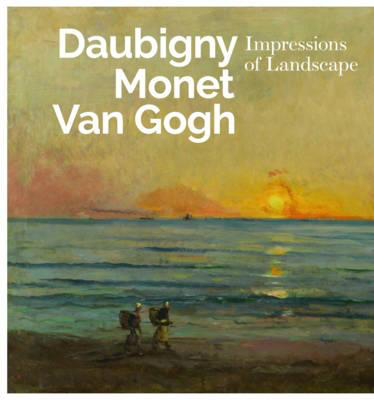
Inspiring Impressionism | Daubigny | Monet | Van Gogh
25th June − 2nd October 2016
Scottish National Gallery | £11 (£9)
It is not often you discover an artist that you had never heard of, but is actually really really good.
Yesterday I had planned to listen to Darran Anderson discuss High Rise (by JG Ballard) at the Edinburgh Book Festival. Unfortunately when I checked Twitter he was stuck at Charles De Gaulle airport and was going to miss his sold out event. I was already taking a half day off work, so I found myself with a morning to fill in Edinburgh. I swung by the Royal Scottish Academy (the big neoclassical art gallery on the Mound that is nearest to Princes Street). There was an exhibition on Daubigny and the Impressionists, so I went to see that.
Like most people I am familiar with the Impressionists, and have various books of their works. Although the paintings reproduce well, and the movement was an overdue shot in the arm for moribund landscape painting, seeing the paintings in person is often an underwhelming experience. The works can come across as flat and decorative. Daubigny I had never heard of, and I presumed it was an opportunity to hang some familiar impressionist paintings from local galleries along with some musty predecessor
As it turned out Daubigny was an absolute revelation. He is one of those rare artists where is it hard to consistently identify the works as all being by the same artist. He had a sense of humour, sketching his life in a boat that he used as a floating studio, he could do the detailed landscapes in dark tones that are familiar in countless galleries, but also blast out painted sketches that captured some momentary light effect with the setting sun or suchlike. He loved to experiment with paint, getting effects that are quite remarkable.
He was capable of capturing the light, detail and mood of a scene. Often I would slip off my glasses and the blurred image before me could pass for the reality of a day in France long ago, but there still before me. To my taste generally his works showed the weaknesses of the neighbouring impressionist works, though there were a few where it seemed that Daubigny had raised their game too.
With Daubigny the reproductions do not do him justice, there is no substitute for the real things, a highly recommended exhibition, offering an opportunity to see the range and power of a major artist and the influence he had on art history.
I do rather wonder whether it was Daubigny who was the model for the painter Elstir in Proust, although Wikipedia suggest Monet as the model.
https://www.nationalgalleries.org/whatson/on-now-coming-soon/inspiring-impressionism/